
The best way to handle a negative Airbnb review is to pause for 24 hours, investigate the guest’s claims objectively, and then write a calm, professional public response that focuses on the actions you’ve taken to address the issue. My name is Hemang Bhatt, and at my company, Stayvanah, we use this exact framework to manage reviews for our co-hosting clients across Charlotte. A well-crafted response is not for the guest who left the review; it’s for all the future guests who need to see you are a responsive and professional host.
At Stayvanah, we provide expert short-term rental co-hosting, not traditional property management. This distinction is key for investors. As a licensed North Carolina real estate agent with HBMCRE and eXp Realty, I help investors acquire and optimize STRs, and our co-hosting model is designed to maximize their returns while they retain full control and ownership of their asset.
Why a Bad Review Response Is More Damaging Than the Review Itself
A drop in your average star rating directly impacts your listing’s visibility and earning potential in the Airbnb algorithm, which heavily favors listings with a 4.8-star rating or higher. A dip from 4.9 to 4.7 can cut your search impressions significantly. But often, an emotional, defensive, or dismissive public response from a host is even more damaging than the initial 1-star or 3-star review. Future guests scan reviews specifically to see how you handle problems. Your response is a critical test of your professionalism.
For example, we A/B tested two nearly identical units in the same building in Optimist Park. The unit with a 4.92 rating consistently booked up 25% faster and at a 15% higher average daily rate (ADR) than the one with a 4.78 rating. The difference wasn’t just the review score; it was the host’s responses on the lower-rated listing, which were argumentative and scared off potential bookers. This is why a systematic approach to Charlotte short-term rental property management, delivered as co-hosting, is non-negotiable.
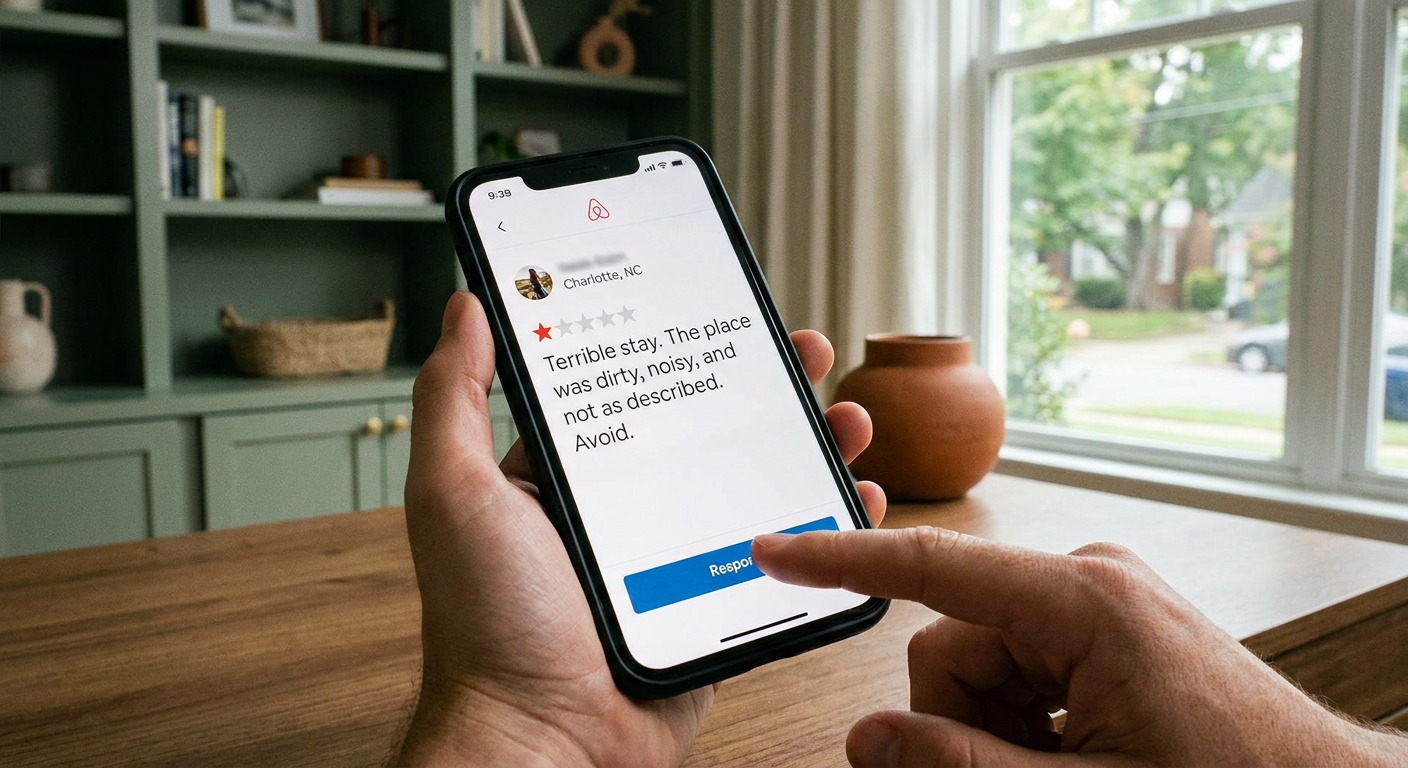
The 3-Step Framework for Responding to a Negative Review
What you do in the first 24 hours after receiving a negative review is critical. Acting with emotion is a recipe for disaster. This is where a clear, pre-defined process becomes your most valuable asset. Follow these steps without deviation.
Step 1: Do Not Respond for 24 Hours
Your immediate instinct will be to write a rebuttal, defending your property and pointing out the guest’s inaccuracies. Do not do this. An emotionally charged response looks unprofessional and signals to future guests that you are a difficult host who doesn't take feedback well. Close the app. Take a walk. Your first draft will be written for yourself; your second will be for the guest; but the final draft must be written for all the future guests who will read it.
Step 2: Investigate Every Claim Objectively
After 24 hours have passed, it’s time to put on your operator hat. Read the review again and break down each complaint into a verifiable claim. Treat it like an incident report, not a personal insult.
| Guest Claim | Objective Investigation | | :--- | :--- | | “The Wi-Fi was too slow to work.” | Check your Wi-Fi speed history. Was there a documented outage? Run a speed test now. What speed is advertised in your listing? Is there a mismatch? | | “The apartment was dirty.” | Review your cleaning team’s post-clean photos for that turnover. Time-stamped pictures are your best evidence. Do you see evidence supporting the claim? | | “The neighborhood was loud and sketchy.” | Is this the first time you’ve received this feedback? How do you describe the neighborhood (e.g., NoDa, Plaza Midwood, South End) in your listing? Is it accurate? |
This fact-finding mission is the foundation of your response. It allows you to reply with data, not drama.
Step 3: Write a Professional Public Response
Your public response is your most powerful tool. It’s not for the guest who wrote the review; it’s a marketing asset for the hundreds of potential guests who will scrutinize it. The goal is to appear reasonable, professional, and proactive.
Follow this simple, four-part formula:
- Acknowledge and Thank: Start by thanking the guest for their feedback. ("Thanks for staying with us and taking the time to share your experience.")
- Apologize and Empathize (If Warranted): If your investigation confirmed a legitimate issue, own it sincerely. ("We sincerely apologize that the bathroom cleanliness did not meet our standards.")
- State the Action Taken: This is the most crucial part. Explain what you did to fix the problem. ("We have had the drain professionally cleared and retrained our cleaning staff using our 50-point inspection checklist.")
- Reiterate Your Standards: Briefly reaffirm your commitment to a great guest experience. ("We are committed to providing a 5-star stay for every guest, and your feedback is crucial in helping us improve.")
This approach shows prospective guests that even when things go wrong, you are a responsible host who will make it right.

When Should You Ask Airbnb to Remove a Review?
You should only try to remove a review if it clearly violates Airbnb’s Review Policy. Wasting time trying to remove a review that is simply negative but doesn't violate policy is a mistake; focus on your public response instead. Valid reasons for removal are very specific and include:
- Extortion: The guest threatened a bad review to get a refund or discount (and you have proof in the Airbnb message thread).
- Irrelevant or Retaliatory: The review doesn’t discuss the stay itself (e.g., complains about the airline) or is clearly in retaliation for you enforcing house rules (e.g., charging for a party).
- Contains Private Information: The review includes your address, full name, or other personally identifiable information.
To dispute a review, report it directly from your dashboard and provide a concise explanation with any evidence. However, be aware that Airbnb sides with guests in most cases. Do not rely on removal. Your public response is your primary and most effective tool for reputation management.
Frequently Asked Questions
What is the difference between co-hosting and property management?
The main difference is that with co-hosting, you, the owner, stay in full control. Our model of Charlotte short-term rental property management is delivered as co-hosting—you keep the title, the Airbnb/VRBO listing in your name, and all direct payouts. Stayvanah operates as your partner for a flat 18% fee, managing everything from guest communication to turnovers and dynamic pricing, whereas traditional property managers often take over the listing and charge a complex mix of fees.
Should I offer a refund for a bad review?
Generally, no—especially not in exchange for changing a review, which is a form of extortion. If a guest had a legitimate, major issue that you failed to resolve during their stay (e.g., no heat in winter), a partial refund might be warranted as a gesture of goodwill. However, never offer a refund after the review is posted in hopes they will remove it. Focus on your public response.
How can I prevent negative reviews in the first place?
Preventing negative reviews starts with proactive management and setting clear expectations. This includes professional photography, accurate listing descriptions (especially regarding noise and location), and robust, systemized cleaning and maintenance processes. At Stayvanah, our entire co-hosting service is built around creating repeatable, 5-star experiences that minimize issues before they can happen. As an STR-focused Realtor, I also help investors identify properties less prone to guest issues through my Charlotte STR Realtor services.
Written by Hemang Bhatt, Charlotte STR realtor and founder of Stayvanah — licensed North Carolina real estate agent with eXp Realty.
Ready to take the next step?
If you own a Charlotte-area property — or you're considering buying one — Stayvanah can give you a real-numbers picture of what it would earn as a short-term rental. We deliver Charlotte short-term rental property management as co-hosting: you keep the title, the listing, and the payouts.
👉 Get your free earnings estimate
Prefer to talk it through? Schedule a call with Hemang — founder of Stayvanah and a licensed NC real estate agent specializing in STR.